

Well, hello. Let’s start with a name. I’m Christina. Christina Wood.
*nudge nudge* This is where you introduce yourself.
Ah, perfect. It is so great to meet you.
Now, where do we go from here? You’re on a page that is literally titled About Me, so I’ll assume you’re interested in who I am. Seems only fair.
From the beginning, then.
I was born in New Jersey, in a little town about 45 minutes out from Manhattan. Even though I was very young when we moved away, I had already had that east coast, Garden State, green plants and bright lights blood pumping through my veins.
My great aunt who was more of a grandma to me than anything else, was a major fan of the arts, and because of her, I spent my Jersey summers learning the differences between Impressionists and Post-Impressionists, creating paint-off scenarios in my head between Degas and Van Gogh. Vincent always won. Oh, she also introduced me to Shakespeare, which I suppose was a largely formative piece of my identity puzzle.

“And when I read, and really I do not read so much, only a few authors – a few men that I discovered by accident – I do this because they look at things in a broader, milder and more affectionate way than I do, and because they know life better, so that I can learn from them.”
– The Letters of Vincent van Gogh
Now, I know what you’re thinking. You were a child. You couldn’t have possibly enjoyed Shakespeare.” Aye, there’s the rub.
At 6-7-8 years old, I didn’t quite appreciate everything the bard was telling me, but kids understand stories in more than words. A tone can carry weight. Sometimes, it’s less about understanding verse by verse, and more about learning the importance of stories and the enduring power of storytelling. As I got older, I started noticing similar plot points between my favorite movies and Shakespearean stories I’d learned about and, after thinking about it, I realized that many of his stories were influenced by ancient myths or real lives past. Stories may carry similarities, their authors borrowing, twisting, melding stories they’ve heard from others into their own words, crafting a tale all their own.
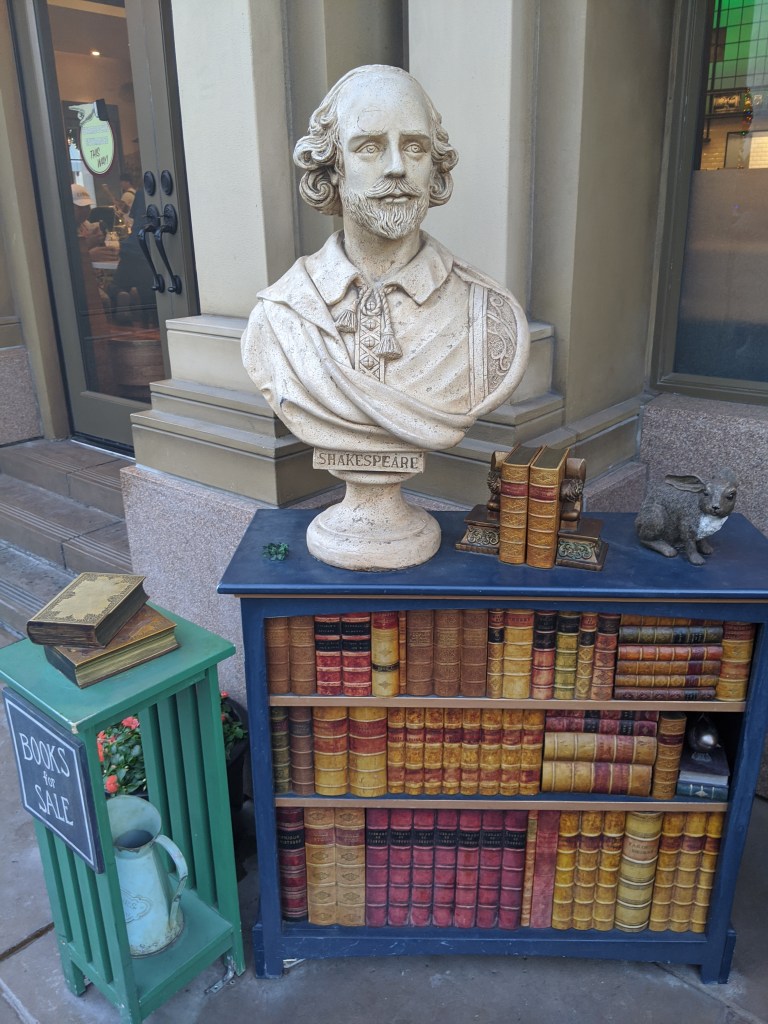
It’s why I’ve always thought that if I look at a person as a story, I can understand them better. Stories make fortune tellers of us all.
Let’s fast forward.
In 5th grade, I wrote an essay. The assistant teacher thought I plagiarized it and gave me a C. After I swore up and down that I hadn’t, and he rightly couldn’t prove his incorrect theory, it got bumped to an A. I’m still not over it. Imagine if I took that guy’s criticism to heart and been afraid to try as hard as I did on that paper. I wish him well, but I hope he’s found a calling that isn’t teaching.
In 9th grade, my teacher nominated me for a writing award after I’d only been in the class for a couple months. They put my name in a book, sent me the book. It was very cool for a kid. Throughout the rest of high school, I spent most of my time either in the choir room or reading and picking apart my Language Arts teacher’s brain.
In all my jobs, I always came back to the words and the stories. Even in the jobs that had nothing to do with copywriting, I still found a way to make stories. You want me to upsell espresso? Let me weave you a tale about the woman who developed powers of supernatural speed after drinking our quad-shot vanilla latte. This person has no idea how credit works? I can tell them The Tale of 3 Credit Bureaus.
What are stories, in the end, if not a way to bring us together and communicate?
There’s more than one way to tell a story. If a picture tells a thousand words, what story is my Insta telling about me?
 A Written Wood